
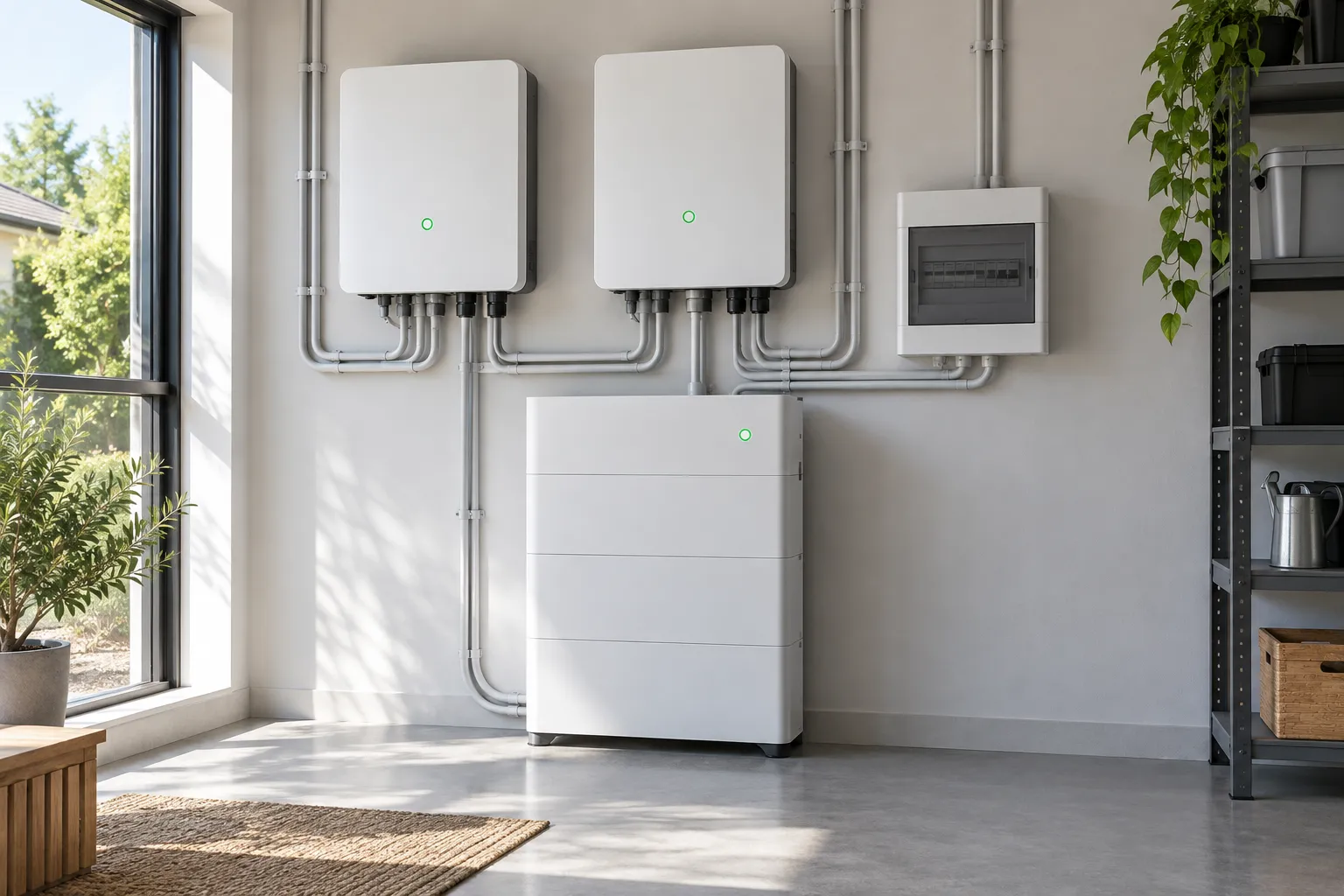
Battery energy determines potential duration; output power determines which loads it can supply.
- Load in kWWhat needs power
- HoursHow long you need it
- Energy in kWhLoad × running time
Use kW and kWh for different questions
Power, measured in kW, is the rate at which electricity is supplied or consumed. Energy, measured in kWh, is the amount used over time. Storage systems have limits for both. The US Department of Energy explains this distinction in its solar and storage guide.
For illustration, a steady 1 kW load running for four hours needs 4 kWh delivered to that load. The installed battery must account for conversion losses, usable capacity limits, reserve settings, and other design requirements. This calculation is a starting point, not a final battery specification.
Build an essential-load list
Write down the appliance, its power requirement, and the period you expect to use it. Separate continuous loads from occasional ones. Refrigerator compressors and pumps can start and stop, so appliance labels alone may not describe the full operating pattern.
Discuss which circuits will have backup and which will stay outside it. Knowing that boundary helps everyone in the household use the system sensibly during an outage. Ask the installer to label or document the agreed backup circuits at handover.
Check usable capacity and compatibility
Ask how much energy the battery can deliver within the proposed operating settings, not just its nominal capacity. Also ask for continuous and peak output limits, the installation location requirements, and the manufacturer’s warranty conditions.
Confirm the exact inverter-battery combination against current manufacturer guidance. A later addition should be planned around supported models and expansion rules. Buying a battery now on the assumption that it will fit any future inverter can limit your choices.
Plan the settings as well as the hardware
Decide whether your priority is outage reserve, evening use of stored solar, or a balance of both. Ask how the settings affect the energy available when an outage begins. A battery that has already supplied the evening load will not have the same reserve as a fully charged one.
RENS can review your load list and discuss a suitable hybrid and battery arrangement. Bring details of any existing inverter and batteries to the survey, including model numbers. That lets us assess whether an upgrade can use the equipment you already own.
About this guide
RENS guides explain solar planning and the questions to ask before installation. General guidance and illustrative examples do not replace equipment instructions, current local rules or a site-specific design.
Spot something that needs updating? Email the RENS team with the guide title and the detail to check.
Sources & further reading
References supplied with this guide. Check the latest rules before making a decision. Overseas consumer guides explain general principles; Pakistan’s connection rules and your equipment instructions take precedence.
Make it specific to your site.
Bring your questions to a free site survey. We’ll discuss your needs and prepare a proposed solution with a feasibility report.
Explore battery storage services